
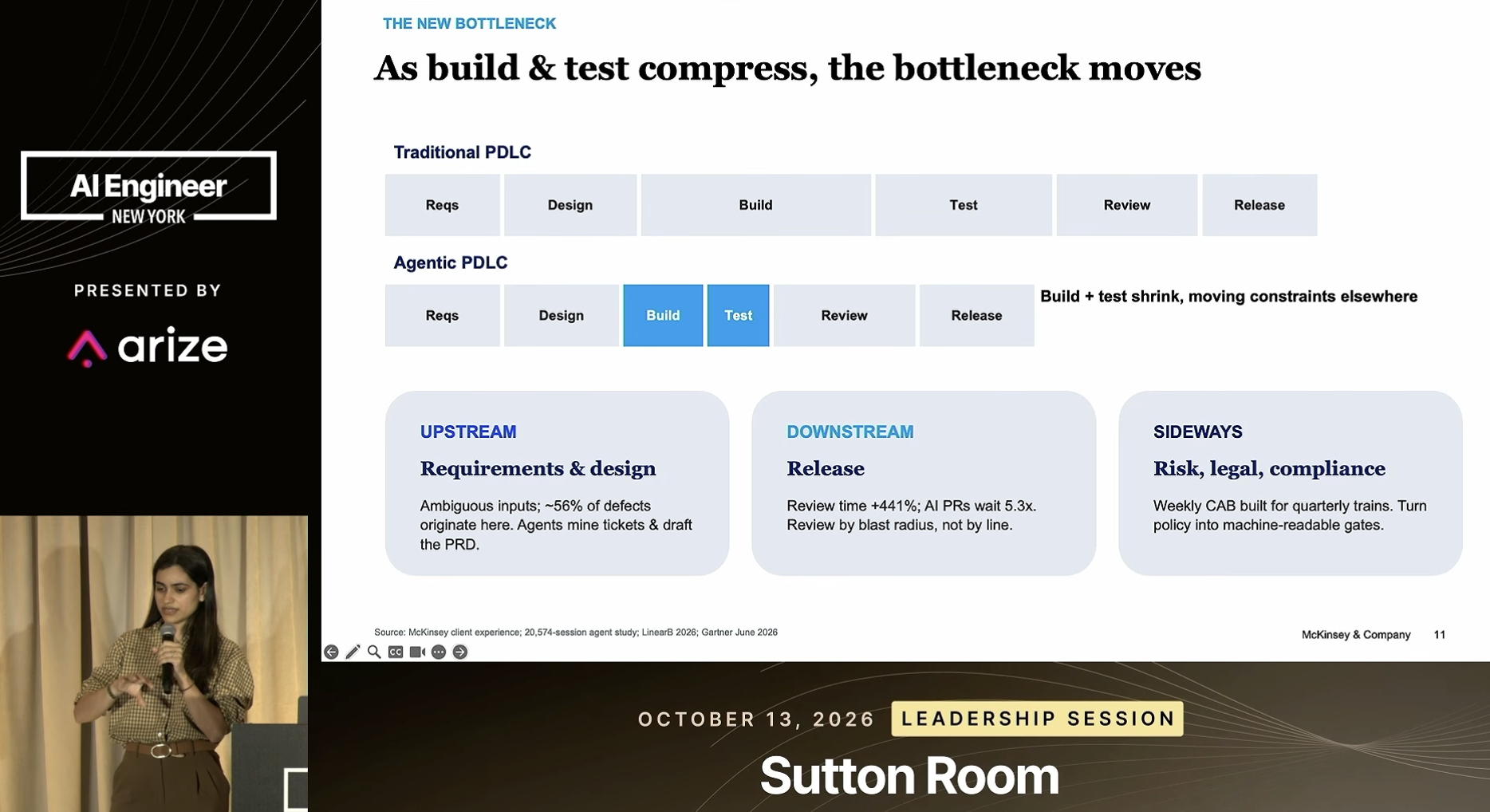
As we have outlined in other articles here, the human centred elements of software development are becoming disrupted. SAFe already announced that in AI Native organisations, sprints are no longer relevant, with a shift from quarterly planning to monthly. Sonar outlined how AI is going to blow up continuous deployment because each merge can be up to 30k lines of code. Gartner explaining that this not just shift left. Team Liftoffs data showing that creativity is key. McKinsey here talks about a complete overhaul of the operating model.
All of this goes back to where the bottleneck lies. Previously in development. Not anymore.
Sprints
Two week sprints were timeboxes to develop the next iteration. Agents can no do this in a night shift, and humans verify in the morning. The two week dev sprint doesn’t apply to agentic development. We may still however see the full end-to-end within a sprint (from idea to release), but a kanban pull approach is more readily adopted by teams working with agentic SDLCs.
A key factor is guardrails for where the human review happens.
Context
A lot of enterprise expertise is ‘stuck’ in people’s head. A question was how do agents get it? We have already had an enormous shift from colocated teams to suddenly remote teams during COVID. This meant all information needed to shared and stored on internal systems. Teams that transitioned to remote-first will be well suited to empowering agents. Atlassian and Notion build their whole business model on this approach.
Artefacts
Consistent standardised artefacts are crucial. They double up as an audit trail. After all, the organsation is an enterprise and has a responsibility for what it outputs and thus there needs to be an accountability at each incremental part. This also impact quality. Teams cannot just create sloppy requirements and ‘hope for the best’ by letting ai take over or make assumptions.
Teams
Whilst headcount isn’t reducing (remember: existing roles are sticky, difficult to get rid of, whilst new roles aren’t sticky), big teams are fractalising into smaller teams, or even pods. In terms of terminology, a team has typically referred to 5-9 people being an optimal size. Team Topologies famously made the cognitive load of the team the main bottleneck, again this will probably blow up as well. In the new lingo, a pod is more 2-4 people. An absolute Minimum Viable Team. The depedencies between teams will skyrocket and traditional team ledership will shift to dependency removal.
Roles
The roles are collapsing, but we have seen this happening anyway:
- product / sme
- build
- agent ops
We have seen loads of different interpretations. These roles are not yet universally codified so we will continue to see change here I believe.
Metrics and data
An absolute key element for productivity, finding bottleneck and defining quality, but most organisations are absolutely dreadful at this. Usually combination of sloppy tickets, a disdain from teams for self-accountability and a lack of skill amongst leadership to pull up the data. This is an absolute must looking ahead at this AI agentic world.
Scaling
Massive gains at small teams, or at an individual basis, is not uncommon. 10x here, 10x there. The scaling (i.e. the systemising and roll out) across an enterprise is a whole different proposition. This is, of course, where transformation needs to happen (hard change as it’s known!) which then in turns impacts everything above at a global org level: roles, responsibilities, permissions, workflows, dependencies, toolchains.
Quality
Often we see how important it is to balance competing metrics. As speed goes up, quality often goes down. The book ‘sooner, safer, happier’ pretty much nailed, in one, what orgs want. But essentially code quality at scale (in line with the second law of thermodynamics) has a tendency towards chaos, not order. Guardrails, contexts, harnesses need to be in place beforehand. It cannot come after.
Where are the bottlenecks?
Upstream. How fast your write requirements. But nore: Ambigous inputs account for 56% of defects.
Downstream: How fast you can then check the work and release
Sideways: Change approval boards – still in line with quarterly cadences of enterprises This is an interesting example where Liftoff can really help to map out all the different teams in the org and who needs what (whether compliance, tax, legal, hr). Most teams do not do this!
Spread of AI and its impact
Close to 90% of developers are now using AI.
Only 20% are using engineering metrics to track. This is in line with what we have seen in the Xpertise leadership survey and Notion.
Implications
Organisations and leadership need to:
- set up the data
- get a baseline
- set up governance
- transform the SDLC process (as per data)
- visualise the interacitons between teams (the exchanges)
- set definitions of quality and hold accountable
- set expectations for artefacts and hold accountable
- reassure the team and refactor into minimum viable teams
- clearly outline objectives and KPIs with time bound results